

SCIENCE
Is Cooking Science?
‘Give me a child for the first seven years, and you may do what you like with it afterward.’
Starting with this famous maxim, we know that children’s formative years are very important for nurturing and development, hence deliberate efforts need to be taken to shape this foundation. Studies have shown that children have an exponential ability to think and learn even at a very young age. Therefore, children should be provided with a more engaging and challenging environment to promote active learning and purposeful play in children.
Science involves the understanding of the natural world through a process known as scientific inquiry (Duschl et al, 2007), which allows children to explore different styles of learning. As mentioned by Minister Ong Ye Kung (2018), learning should be fun and it is important to nurture the joy of learning
in our students. ‘Learn for life’ is a value, an attitude, and a skill.
Cooking allows children to:
- Understand the natural world
Planting and maintaining fruit, vegetable or herb garden shows children the origin of food and different methods of food production. For example: growing plants from seeds or underground root or underground stem. Gardens are tools used to teach children the science concepts of the natural world involving plant growth; medicinal uses; nutritional value of food and food origin. Hence, they witness andexperience the process of food coming from the natural world into the kitchen and onto their plates.
2 Participate in inquiry-based learning
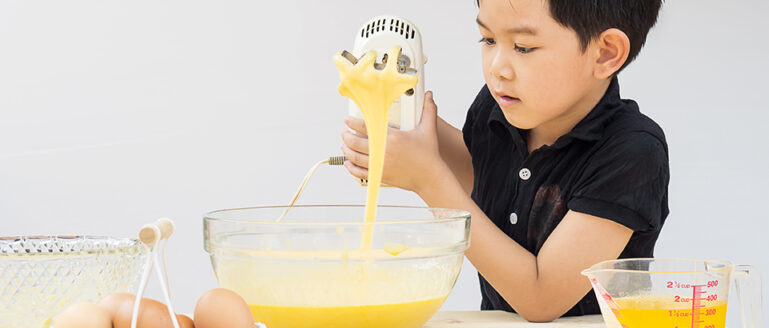
Cooking involves the children participating in the entire process of food preparation; cooking and eating. They provide opportunities for children to develop in skills such as: exploring with their five senses; raising questions; making observations (Worth, 2010).
As parents we can use a simple ‘Engage-Explore-Reflect’ cycle (Worth 2010)to facilitate children’s learning experience through cooking. Parents can ask questions “Where have you seen flour?” and “What do they look like?” We can allow children to explore further by providing them with flour, water, food coloring and eggs.

3 Understand simple science knowledge
The kitchen is like a mini science laboratory to children as they observe how ingredients change color, texture and form. We can include simple science knowledge about weight, shape, size, color; learn concepts of living and non-living things (plants and animals) as we guide and conclude the children’s learning.
Increasing we have seen how the introduction of science in children helps children not just in their physical and socio-emotional development, it also helps them to develop life-long scientific skills that have long term impact on their learning and education.