

MATHEMATICS
The only way to learn Math is through Rote Learning. True or False?
As parents, we will want the best for our children. We will want to provide them with the best education to bring out their fullest potential. We are receptive to try out a variety of methods to help our children with their academics. We make learning Math fun and interactive, hoping they will learn effectively. But at the end of the day, we forget an important aspect about our children. Children have an innate drive to play, and playing helps these little ones flourish academically, socially and emotionally.
Studies have shown that there is a correlation between learning and anxiety levels. If you children feel anxious, their ability to learn will be impaired. Parents need to be aware of this and realize that there are times children just want to play and explore their surroundings.
Imagine this in a preschool setting: “I have 3 bears, and you have 4”, exclaimed Tommy. The
children gathered in a circle and Teacher Melina joined them in their game. Inspired, she
encouraged the children to count the number of bear counters they had. Subsequently, Teacher Melina introduced the concept of “More and Less”. Not before long, children were able to compare and identify who had more bears, or less bears. This incidental play is a fine example of how children can learn Math through play, while interacting with their peers.
What are the concepts my child should know? How should I
introduce those concepts?
There are several mathematical concepts children should be exposed to during their years in
preschool. Understanding these concepts and the related terminology will enable children to
feel confident and assured when navigating primary math. Read on to find out what are some
of the concepts children have to be aware of before entering formal education.
Numbers
Numbers are the first thing children learn from their environment. Parents may hear their children shouting out sentences such as, “I have five sweets”, albeit their children have not
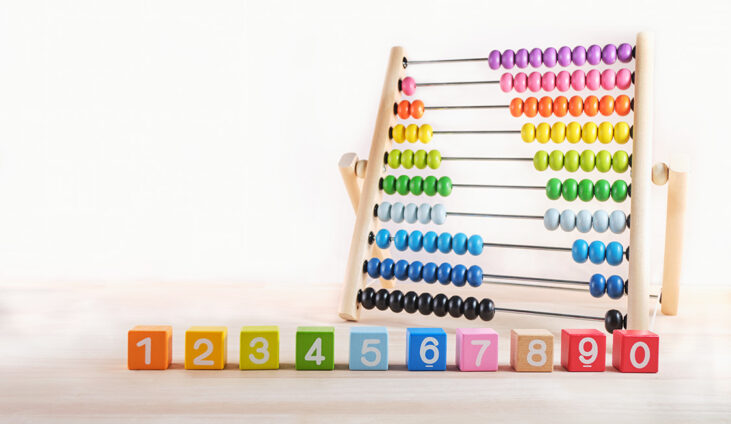
learnt to count yet. Your children have just begun to gain number sense and you can facilitate their learning through purposeful play. One of the earliest skills children should know is one-to-one correspondence and since children are visual learners, try to start by using concrete objects. Examples of concrete objects are Lego, candies or your children’s favorite fruits. Lay out the objects and each time your children point at each object, have them say the numeral
name aloud. Subsequently, parents can conduct activities whereby children need to match the numeral according to the number of objects in the group.
Shapes
Shapes is a concept you can talk about anytime and anywhere. While you are in the car with your children, have them talk about the shapes they see, for instance, the road signages, traffic lights and buildings. By conversing with your children, you are giving them a chance to apply their knowledge. If time permits, you can consider reading the book, “When a Line Bends…A Shape Begins” by Rhonda Gowler Greene to reinforce your children’s understanding about shapes.
Facilitating Children’s Play
Child-facilitated play is just as important. Children need to be given the freedom to play and
explore. In moments like these, parents can provide tools like rulers, containers and manipulatives. You can even pose challenges to children. This maximizes children’s learning potential as they feel empowered and encouraged to explore.
Studies have shown that there is a correlation between learning and anxiety levels. If you children feel anxious, their ability to learn will be impaired. Parents need to be aware of this and realize that there are times children just want to play and explore their surroundings.
As parents, there are moments you will feel perplexed and confused about how to impart
mathematical concepts to your children. One of the most important tips is to look out for
opportunities to help children think and learn. With rote learning, this is hardly possible.
Children may feel constrained but when they are given the chance to navigate their
Mathematical journey creatively, they develop a lifelong passion towards it.
Is this not the essence of learning?