

SCIENCE
Science and Preschool
Why is Science important for kindergartens?
Even though science is not formally introduced to students till primary three, science education for pre-primary children is of paramount importance as it provides external stimuli which aids a child’s development.
Starting from a young age, science helps a child to shape their development. As your little one learns to ask questions, make observations and share their findings, they are developing critical-thinking skills.
This is essential as the Ministry of Education (MOE) has placed an emphasis on developing critical thinking in its syllabus for primary education.
The Benefits of Learning Science
Research has shown that students begin to show an interest in science, technology, engineering, and mathematics (STEM) during the years of their primary education. Hence, it is crucial to expose your child to science, which is the foundation of STEM. This ensures that your child would develop an interest and knowledge in these subject areas. which would be crucial for an increasingly digitalised economy.
Fun and Interactive Ways to Help Your Child Learn Science
Explore, Explore and Explore!
Science is present all around us, which is why a visit to the zoo, aquarium or even your park and provide many learning opportunities.
Always engage your child and encourage them to question what they see around them. If there is something you are unsure of, do not just brush them away or push the question till a later time. Research and discover the answer as a team.
You do not need to know all the answers! In fact, you asking the questions you would be demonstrating curiosity to your child, encouraging them to act in a similar fashion.
Get Some Equipment
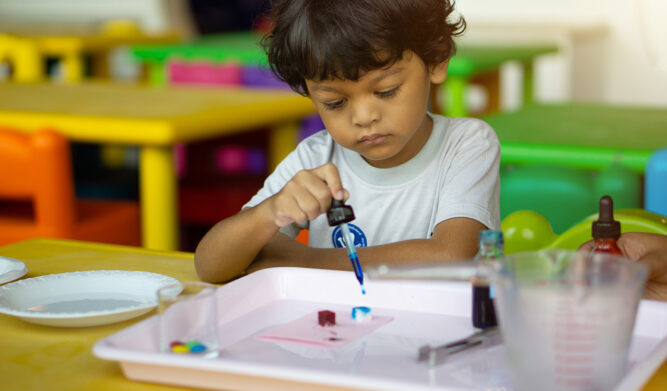
Investment in a few pieces of scientific equipment goes a long way.
For example, pairing a microscope along with a journey to the beach will unveil a whole new world to your child when they look at sea water under the microscope. You can turn a casual activity into an evening of wonder and learning for the little one.
In addition, there is a wide range of scientific kits such as astronomy kits, ant farms, botany kits, kitchen science kits and food science kits.
Doing these activities with your child can be great fun while sparking his or her interest in the world around them at the same time.
Put Interests First
Always consider the interests and personality of your child when you plan activities in mind.
Although Daddy might like dinosaurs, junior might not like them. Similarly, there is no point in forcing a child to go to the beach in the name of science when he or she detests the outdoors.
Being mindful of what your child wants to do is important to keep the wonder and fascination for science going strong. A bad experience can form a negative opinion, causing them to view science as something bothersome or not worth their time.
From zoology to astronomy, botany to chemistry, encourage your child when he or she expresses interest in a particular field.
Remember, you are the first teacher that your child gets. Go out and explore with your child to create amazing learning experiences that will awaken the young scientist in them!

TIPS & TRICKS
Being mindful of what your child wants to do is important to keep the wonder and fascination for science going strong. A bad experience can form a negative opinion, causing them to view science as something bothersome or not worth their time.